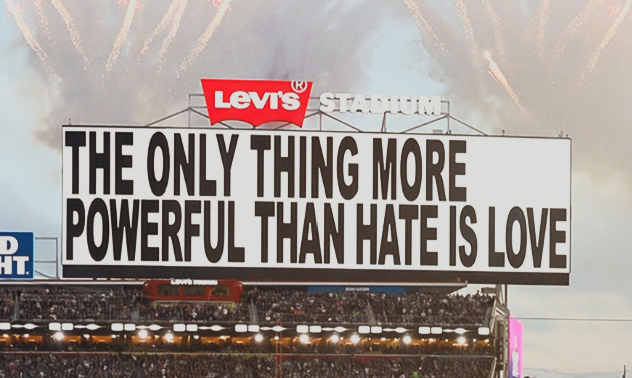

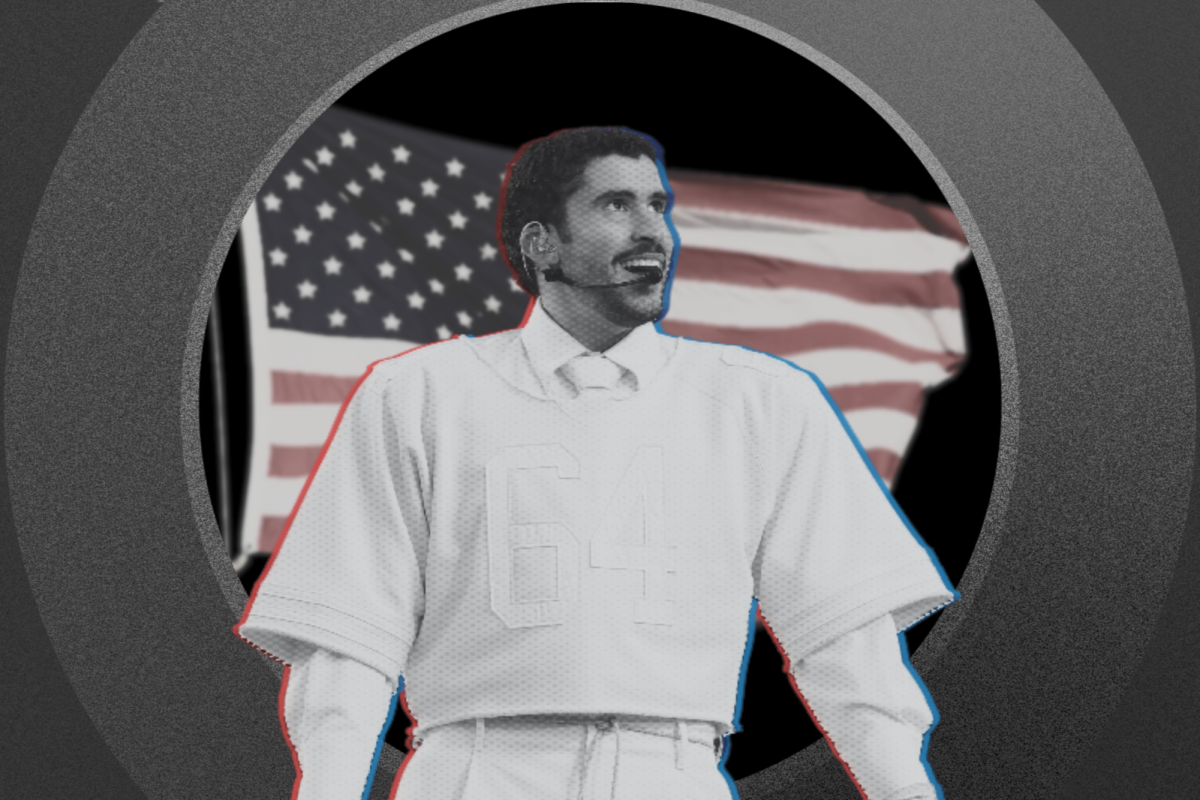
Fireworks erupted above Levi’s Stadium as “Debí Tirar Más Fotos” reverberated throughout millions of living rooms across the country. Bad Bunny exited Levi’s Stadium with a crowd of people following behind him, all singing along with a man who has become the most prolific music virtuoso of our time.
After the show concluded, people flooded social media to express their opinions. Some gave praise, while others accused the NFL of making a political statement by selecting Bad Bunny as the halftime performer for Super Bowl LX.
Yet the spectacle unfolding on the field looked less like a campaign and more like a message of unity. In reality, Bad Bunny was chosen for financial reasons. The political meaning some viewers projected onto the performance says more about America’s polarized climate than about the NFL’s intent.
The Super Bowl halftime show is not a political forum; it is one of the most valuable advertising platforms in the world. Every element of the broadcast is engineered to maximize viewership, sponsorship value and global reach. To summarize, the halftime show makes the NFL a significant amount of money.
Each year draws high viewership, with the last four shows ranked among the five most-watched halftime performances in history. Bad Bunny’s performance ranks fourth all time, with 128.2 million viewers.
With numbers like that, the NFL could have any mainstream artist headline the Super Bowl to generate attention and revenue. It’s fair to ask: Why Bad Bunny?
Cultural outreach.
Bad Bunny has evolved from a popular musician into a global phenomenon. His worldwide appeal helps the NFL expand its brand beyond its traditional audience. He became the first solo male Latin artist to headline a halftime show and performed mostly in Spanish, resonating with the growing Latino demographic in the United States. Embracing this audience is a strategic move for a league seeking long-term cultural relevance. By elevating an artist whose reach spans continents, the NFL positioned itself not as partisan, but as globally aware.
In that sense, the selection reflects a broader evolution in sports entertainment. The league no longer markets solely to a domestic, traditional fan base; It competes in a worldwide entertainment economy. Expanding cultural representation through the halftime show strengthens international engagement and reinforces the Super Bowl as the greatest spectacle in sport.
Despite the NFL’s economic rationale, some viewers still interpreted the choice as politically motivated. This view, while debatable, reflects a larger issue in modern America: polarization.
The fact that something as simple as a halftime show can divide the country so sharply underscores the depth of the nation’s political divide. Political polarization has strained the basic respect, love and sense of shared belonging we once extended to one another as Americans.
In a media ecosystem driven by outrage and instant reaction, commentary often precedes reflection. When audiences expect hidden motives, even a performance rooted in music and culture can be reframed as a political maneuver. The result is not greater understanding, but deeper division.
The halftime show itself did not divide viewers; reactions to it did. In a country conditioned to see hidden agendas everywhere, a performance meant to celebrate culture and unity becomes subject to political interpretation. The politics were not embedded in the choreography or music, they were embedded in our expectations. At this moment our minds are conditioned to find anything in the media that could create a narrative to separate us more as a nation, so that’s what we saw; a reason to hate.
Divided We Fall.
Amid the commentary and debate, the performance projected the opposite: a sense of unity. Bad Bunny’s music filled Santa Clara not as a political statement, but as a celebration of culture, identity and shared experience. Fans of every background could take something away from the show, unified by melody rather than ideology.
Pride in one’s heritage should not be viewed as exclusionary, but as an invitation to share cultural richness and to celebrate the diverse threads that form the fabric of the United States. The performance projected unity. Whether audiences chose to see it that way was up to perspective.
Untied We stand.
Long after the show ended, what remained was not a partisan statement but an image suspended above the field. Debate may continue, and interpretations will vary, but the closing visual conveyed a message that needs no transition. It left viewers with a simple truth, one that stands in stark contrast to the politics we project.