

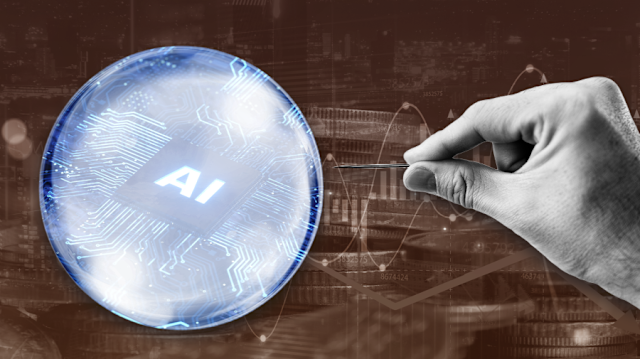
As artificial intelligence continues to reshape the global economy, one St. John Fisher University finance professor says today’s stock market shows both promise and peril.
Dr. Yi Liu, an assistant professor of finance in the St. John Fisher University School of Business, has spent years studying the U.S. financial system, and she maintains a professional and personal interest in AI.
“The market right now is full of ups and downs,” Liu said. “With the elections and the excitement around AI, people will say…are we actually in a bubble?”
AI-related companies, particularly chipmakers and tech giants, have dominated market growth over the past year. Liu noted that AI stocks now account for a large percentage of the S&P 500’s value, leading to questions about whether the surge is sustainable.
“It depends on which part of the market you’re looking at,” Liu explained. “A lot of the current valuations are built into investor expectations. When the expectation for future growth is high, prices go up—that’s just the nature of it.”
Liu compared the rise of AI stocks to previous periods of economic excitement, including the late 1990s dot-com boom and even the 19th-century Gold Rush. But she said today’s environment has one key difference.
“Back then, people were chasing dreams,” Liu said. “Now, companies like Nvidia are selling the tools that make AI possible. Liu says, they’re not just dreams because there is a foundation.
To illustrate her point, Liu described the AI industry as a layered cake. At the bottom, you have companies like Nvidia and AMD producing the chips; this is the support level. Above that are Microsoft, Google, and Amazon, the companies that use these chips. Above that is OpenAI, the San Francisco-based research company that uses those chips to power AI services. Then, at the top, you have the user-facing companies like Duolingo that integrate AI into their platforms.
Liu said that while there’s still hype surrounding AI, the fundamentals look stronger than they did during the dot-com era. “Those companies didn’t have sustainable models,” she said. “AI firms today have real revenue and products that are being used across industries.”
However, she cautioned that even strong companies aren’t immune to risk. “If another country suddenly develops cheaper chips, the entire foundation could shift,” she said. “And with billions of dollars being poured into AI development, some of that investment may not pay off.”
For everyday investors—especially students and those new to the market—Liu offered a simple takeaway: stay patient and diversified.
“Focus on long-term growth,” she said. “Don’t chase the dream,” and “Diversify your portfolio—include international stocks, too, because they give you a different perspective and help balance the risk.”
Despite uncertainty, Liu remains optimistic about the market’s future as technology continues to evolve. “Ups and downs are normal,” she said. “The key is not to panic with every change, but to build a strategy that lasts.”